Newsletter & Journal 2.9
VOLUME II NUMBER 9

Co-Presidents: Bea Hamm & Sarah Hepburn
Treasurer: Mo Clark
Secretary: Rebeca Kerr & Ian Kerr
Board of Directors: Monique Fisher, Elise Gouge, Marie Hinds
Website: Rebeca Kerr & Monique Fisher
Editors: Bea Hamm & Rebeca Kerr
Please send your content and pictures to us at: nebcrnewsletter@gmail.com

Featured: Nellie
Wishing Nellie luck in her search for a new family to love.
I must say she looks pretty happy to be looking.
Could it be you? Click here to see if she could be a good fit for your family.
Always, always can use more foster homes.
Introducing NEBCR Member Katie Anderson
Hello everyone!
My name is Katie Anderson and I live in on the coast of Maine. I first fell in love with Border Collies as a child when my parents decided that bringing home a BC puppy to a family with 3 kids under 10 living in a busy Connecticut neighborhood with a postage stamp yard was a good idea (ironic, given this is the very situation that many BCs we are contacted about are relinquished from). It was love at first sight for me, even when the puppy threw up all over me on the way home. Chicory turned out to be the perfect fourth player for countless 2 v 2 soccer games. I have so many fond memories of her impressive goalie skills, taking her to training classes, and going off to explore trails with her during my brother’s boring baseball games. Even after Chicory had gone and my family decided it wasn’t ready for another dog, I still managed to get my dog fix by helping a local breeder bring her puppies to classes.
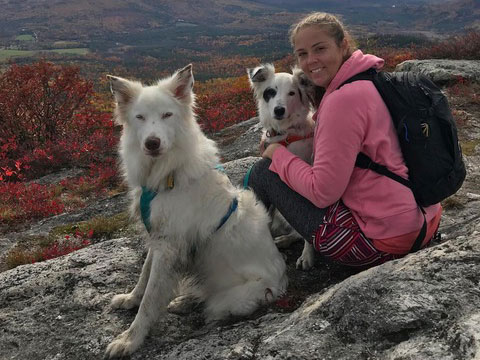
Once I was settled as an adult, I knew a Border Collie would be what I wanted, and an internet search led me to NEBCR and a photo of a white, adorable fluff-ball puppy with piercing blue eyes. Again, love at first sight, but the timing for a puppy wasn’t right. So I applied for another dog on the site. By the time my application was approved, the other dog was adopted, and it was about to be summer vacation (I’m a teacher), so the timing for a puppy was perfect. My family of course thought I was slightly unhinged for adopting a deaf puppy, but Denali won them all over quickly when he came home to Maine in June 2010. He quickly proved to be game for absolutely anything, and that being deaf might actually be an advantage at times. You can read more about him in this year’s calendar, but he introduced me to so many dog sports and experiences.
I decided to become a volunteer about a year after adopting Denali in 2011, and fostered for the first time in 2012. Denali was never a huge fan of other dogs, but always seemed to speak the same language as the dogs we fostered for NEBCR. I’ve learned a lot over the years from all those dogs, but was never tempted to “foster fail” with any of them. I think Denali had something to do with that, as he always seemed to prefer being an only dog. Over the years I also became involved in organizing events and doing intake, and a touch of PR type things here and there. I’m currently taking a break from fostering, but still have a role on intake, help coordinate the Maine Highland Games event we do each year, and manage the NEBCR Instagram account (when I remember!)
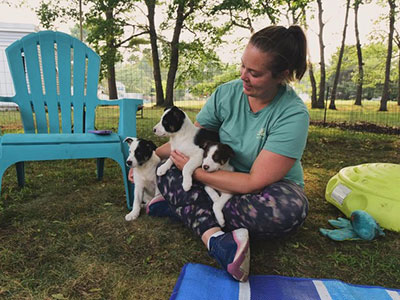
After Denali passed last year, I decided to try fostering without him, and it gave me the opportunity to take in the type of dog that he hated, and so I always avoided fostering a puppy. Which somehow became 4 puppies. You can learn more about the “Maine Quartet” in the NEBCR Year in Review. One of those puppies became my first “foster fail”, Broone. I’m currently giving Broone a chance to grow up and recover from bilateral shoulder OCD surgery before deciding if he likes to foster, but I hope to do it again someday. It’s amazing how someone can end up with a whole slew of random people that somehow feel like your extended family just because they adopted a dog you fostered.
So, thank you NEBCR for 15 great years of adventures (so far!) and friends (both 4 and 2 legged!)
So, You Think You Want a Border Collie?
by Kerry Maloney
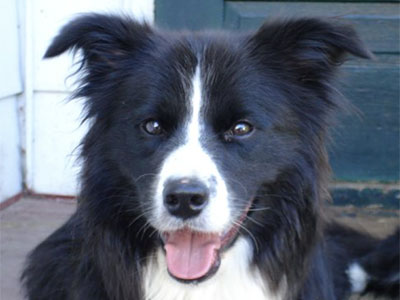
One of the things you can’t really understand about border collies until you live with one is their absolute love of rules. I thought I understood. I knew they would happily follow rules they were taught and that was one of the reasons they were so trainable. What I didn’t realize is that in addition to learning rules they were taught, they would interpret those rules with a precision that would make a constitutional lawyer proud. They also made up their own rules at times, or would insist on enforcing rules (theirs or mine) on the other pets that lived in the house.
I first learned that Dublin had his own set of rules about a year or two after I got him. He had graduated to being free in the house and we had settled into a nice routine. I had started volunteering for NEBCR and had taken on my first foster dog, Mick, an easy-going brindle BC. Mick was a great first introduction to fostering as he loved everyone, was appropriately respectful (scared) of the cats, and playful with Dublin. He loved to wander around the house with a toy in his mouth – which sometimes seemed to really bother Dublin. I couldn’t figure out why this seemed to really bug Dublin at times and at others, Dublin couldn’t care less. As I was watching them one evening – Mick playing with a toy and completely oblivious to Dublin’s stressed pacing – someone walked by the house with another dog and Mick dropped the toy to go investigate. This was the break Dublin was waiting for! He quickly grabbed the toy and ran upstairs. I thought that was odd as Dublin rarely left a room I was in….but it finally dawned on me. Mick had brought that toy down from upstairs – and in Dublin’s mind, upstairs toys belonged upstairs and were not to be played with anywhere else. I watched for a few more days until I was certain, but sure enough, if Mick was playing with a “downstairs” toy upstairs or an “upstairs” toy downstairs, Dublin was stressed out. If he was playing with a toy on its “proper” floor, Dublin was relaxed. Dublin was a polite host however and would not correct Mick – rather he would wait for Mick to get distracted, which would happen fairly often, and swoop in and return the toy to its rightful place.
I discovered the BC precision interpretation of rules one windy spring day. My dogs were taught to stay in the fenced yard unless I gave them permission otherwise. This way, I could leave the gate open as I did yardwork or carried in the groceries and I didn’t have to worry about the dogs getting out or try to manhandle bags of groceries through the gate while trying to prevent dogs from escaping. A few times I had the dogs in the yard and got distracted while putting away groceries and completely forgot the gate was wide open until a while later, but my dogs were still just hanging out in the back yard. After the initial second of panic at my forgetfulness, I’d congratulate myself on successfully training the dogs they couldn’t leave the yard without permission. Or at least that’s what I thought I had taught them. What the dogs learned was that they couldn’t leave through the gate unless I had given permission. This rule (in their mind) only applied to the magic portal that was the gate. This became painfully clear to me one windy spring day. A few pickets of the fence I shared with a neighbor blew down. This was an opening that was not covered by a rule, so was fair game in the dogs’ mind. The newly created hole in the fence was blocked from view by my garage, so I didn’t notice it when it happened. I was busy doing household chores and it was a little while before I realized I couldn’t see the dogs in the backyard. I went out to call them and couldn’t figure out where they were until I saw the hole. I got that awful feeling in the pit of my stomach that every pet owner feels when their pets go missing. I immediately grabbed my car keys and headed out looking for them. Luckily, I found them all fairly quickly, considering they went in three separate directions. Dublin was slow-stalking a car when I grabbed him, Casey was “stuck” in a neighboring yard, frantically trying to dig out a large ball that was still frozen into the ground, and Limerick was fairly certain they were probably breaking a rule by leaving (but not worried enough to actually stay in the yard) so he ran over to my parents’ house and was sitting on the porch, waiting to be let in. That was a valuable lesson for me – BCs are exacting in their interpretation of the rules and are excellent at finding loopholes.
Limerick, especially, loved the structure of rules. He was a reactive dog, especially in his younger years, and rules gave him a sense of security he needed. When he came in from outside, he would go into his crate (a rule he made up as I never required it) and I would give him a treat. This was an unbreakable contract in his mind. I watched his head explode when, unthinkingly, I had decided he was old enough that he no longer needed a crate and stored it away one morning while he was outside in the yard. He came in and started to run toward his crate, but it wasn’t there!! He finally sat in the spot his crate had been located and wouldn’t leave until I gave him his treat. I ended up putting his dog bed in that location so he could have a spot to go to which seemed to satisfy that rule in his mind.
Limerick firmly believed that everyone should follow the rules, even the cats. He would come and tattle on them if the cats were up on the counters or table. One evening, I was on the couch, dealing with bills or some other paperwork. I could hear the cat had gotten up onto the kitchen table and was getting into the new bag of cat food I had left there, but I couldn’t be bothered to deal with it at that moment. Limerick came into the room and poked me with his nose and looked toward the kitchen then back at me in a “Rules are being broken, Food Lady! Do something about it” way. He was giving me the intense BC stare because this was clearly an emergency and I was not reacting with the appropriate sense of urgency. I continued dealing with my paperwork and Limerick stared a bit longer, then walked back out to the kitchen to confirm that rules were still, indeed, being broken – then walked back in to give me the increasingly stressed stare. This finally convinced me to go take care of the cat crimes before Limerick lost his mind.
All of this is to say that living with a BC is always an adventure. I love figuring out their various quirks and rules (or interpretation of the rules).
ASK THE VET: Spring Health Considerations
by Dr. Sarah Hepburn
As spring arrives, longer days and warmer weather create ideal conditions for outdoor activities. However, the season also brings several health risks.
One of the most significant concerns in spring is the resurgence of fleas and ticks. As temperatures rise, these parasites become more active and can transmit diseases such as Lyme disease, anaplasmosis, and ehrlichiosis. Fleas may also cause allergic dermatitis and secondary skin infections. Preventative care, including year-round parasite control and routine tick checks after outdoor activity, is essential.
Seasonal allergies are another common issue, particularly in active, outdoor-oriented breeds. Unlike humans, dogs typically show allergies through skin symptoms rather than respiratory signs. Owners may notice paw licking, ear infections, or generalized itching, especially around the face and feet. Early intervention, along with routine grooming and wiping down paws and coats after exposure to pollen, can help minimize discomfort and prevent complications.
Spring also marks the beginning of heavy seasonal shedding in double-coated breeds. While shedding is normal, excess loose fur can trap moisture and debris against the skin, increasing the risk of irritation or infection. Regular brushing helps maintain coat health and allows for early detection of any skin abnormalities.
As mosquito populations increase, so does the risk of heartworm disease. Transmitted through mosquito bites, heartworm infection can lead to severe and potentially life-threatening damage to the heart and lungs. Consistent use of monthly preventatives and annual testing remains the most effective strategy for protection.
Environmental hazards also become more prevalent in spring. Toxic plants, standing water, and insect stings all pose potential risks, particularly for curious and energetic dogs. Additionally, a sudden increase in activity after a quieter winter can lead to soft tissue injuries or paw pad damage. Gradually increasing exercise levels can help reduce this risk.
With proactive care and awareness, you can enjoy the many benefits of the warm weather while minimizing preventable health concerns.
TRAINER’S CORNER: Teaching Calm
by Elise Gouge, CPDT, CABC Certified Behavior Consultant & Trainer
When we talk about reinforcing a behavior, we mean we are doing something to make that behavior get stronger and stronger. Let’s think of it related to dog training and behavior. In our minds, we might think of it like we are reinforcing our dog to “sit” by giving them a treat or we are reinforcing “wait” by opening the door to run outside. What we often miss is connecting the dots between what we think we’re reinforcing and what behavior is actually getting stronger.
Let’s do a little quiz to dive into this a little deeper.
You ask your dog to sit at the door. They whine, spin around but eventually sit with every fiber vibrating. You say “ok” as you open the door and they zoom out, barking, to their favorite spot by the fence where they often see birds. What’s getting reinforced?
You prepare their food and they are under your feet, super excited. You tell them to “leave it” and they do (albeit some drooling and staring). You put the food down as you say ok, they dive in and eat. What’s getting reinforced?
Amazon comes and your dog runs to the door barking. The delivery person drops off the package and leaves, meanwhile you’re telling your dog to be quiet. What’s getting reinforced?
I think we’d all agree that those examples are aiming to reinforce good manners. We are hoping to reinforce the “sit”, “wait”, and “leave it” commands.
Bear with me as I switch gears for a second and give you a human analogy. You have a morning commute of 5 highway miles. It’s a busy section of highway with merging and exiting. Being on time for work is the goal so you can get a paycheck. You slalom, speed and do some fancy maneuvering to get to work on time. Over time you are quite the speed racer. What’s being reinforced? Yes, you are technically on time and thus receiving a paycheck. But you are also being reinforced, daily, for practicing a highly activated and worked up mindset. The adrenaline of speeding, resulting in arriving promptly and getting a check all factor into the picture of reinforcement.
OK, back to dogs. Yes, you are technically rewarding your dog for a proper sit, wait or leave it. But, you are also reinforcing the practice of being highly activated and worked up. The adrenaline of knowing they are about to burst out the door to chase birds or pounce across the kitchen to dive into a food bowl is a huge part of the picture (just like you speeding to get to work on time).
This really hit home with me the other day when I was working with my seven month old puppy. We were in a basic obedience class and to help keep her focused, I was playing tug with her. She was distracted by the door opening or other dogs barking. She would look but was able to return to me and play. I was really happy that she stayed focused on the play but I was also like, whoa, she was super aroused. I left class and thought about whether I was really reinforcing her for focusing on me. No, I decided, I was reinforcing high arousal and being really worked up. She wasn’t ignoring distractions, she was learning that environmental triggers like dogs or sounds are a cue to go wild and thrash a toy to death.
People that own are used to high-energy life. We play with our dogs, we take agility classes, we herd sheep, we go to classes, we teach tricks and dance with our dogs in our spare time. So it makes sense that we’d accept some high-arousal behavior as par for course. But, it’s important to look at what’s being reinforced over time and if it’s going in the direction we want. If your dog is calmly going to their mat and waiting while you prep dinner or open the door for a guest, that’s great. If you’re seeing an arousal spike in that context or across a multitude of scenarios, it’s time to focus on teaching your dog to be calm versus teaching your dog to sit (or any similar command).
How do you teach calm? How do you teach a mindset? You can’t see it the same way you see a dog sitting. Luckily, you can see all the body language cues that create a calm mindset. You can see blinking eyes (not dilated pupils and wide eyes). You can see relaxed lips and soft breathing (versus wide tongue, panting or pursed lips). You can see a relaxed body (versus a ready-to-go tense body). Having lots of calm signalling is a great barometer to go by and will help you reach goals like calmly exiting a door or greeting guests. It takes time to teach an intense breed like a border collie to master a calm mindset. There are a lot of things you can do in everyday life to promote calm and not indirectly reinforce high-arousal.
- Set up the environment to support a calm mindset. Don’t allow your dog access to hot spots where they will go nuts. Gate off the hallway leading to the front door, use privacy film to cover the window looking out to the driveway or neighbor’s yard. Use a fan, radio or other ambient noise to lower noise triggers.
- Allow your dog decompression time. This means use a crate, ex-pen or tether and give them quiet time each day. They need to rest and recover in order to process and learn.
- Reinforce the art of doing nothing. Avoid cycles of making sure your border collie is constantly stimulated and has stuff to do. Instead, after you know they’ve had their needs met with exercise or enrichment, use a tether or pen to have them settle and just chill while you do other things. Ignore them and allow them to fully settle. Use occasional soft praise or gentle petting versus treats or exuberant praise to let them know they are being a good dog.
- Incorporate impulse control into your training routine and life. Using exercises like doggy zen can help your dog leaps and bounds with handling things calmly.
- Check out other calming routines like some of Leslie McDevitt’s pattern games, Suzanne Clothier’s auto-check-in, Brenda Aloff’s Be Still or resilience training with Bobbie Bhambree. There are tons of excellent online resources to teach calm!
Ultimately, step back and look at your routines to see what you are reinforcing in any given moment with your dog. When you’re not sure, just look at what behavior is getting stronger and more salient. Is it relaxation? Green light. Is it barking, frenzied, wild or super intense? Red light. Knowing what you’re reinforcing is the first step to modifying routines and training so you’re teaching your dog the skills (and mindset!) needed to live a happy, relaxed life.
Shop online and help NEBCR!
NEBCR has over 200 products available in our store with several logo designs to choose from.
Quality merchandise with a speedy turnaround time. Sweatshirts, t-shirts (long and short sleeve), mugs, hats,tote bags.
Something for everyone while providing funding for NEBCR.

Shop online and help NEBCR!
Donate By Shopping sites donate a small percentage of everything you spend to a charity of your choice. When shopping online, please consider using these services to ensure a portion of the money goes to a good cause.